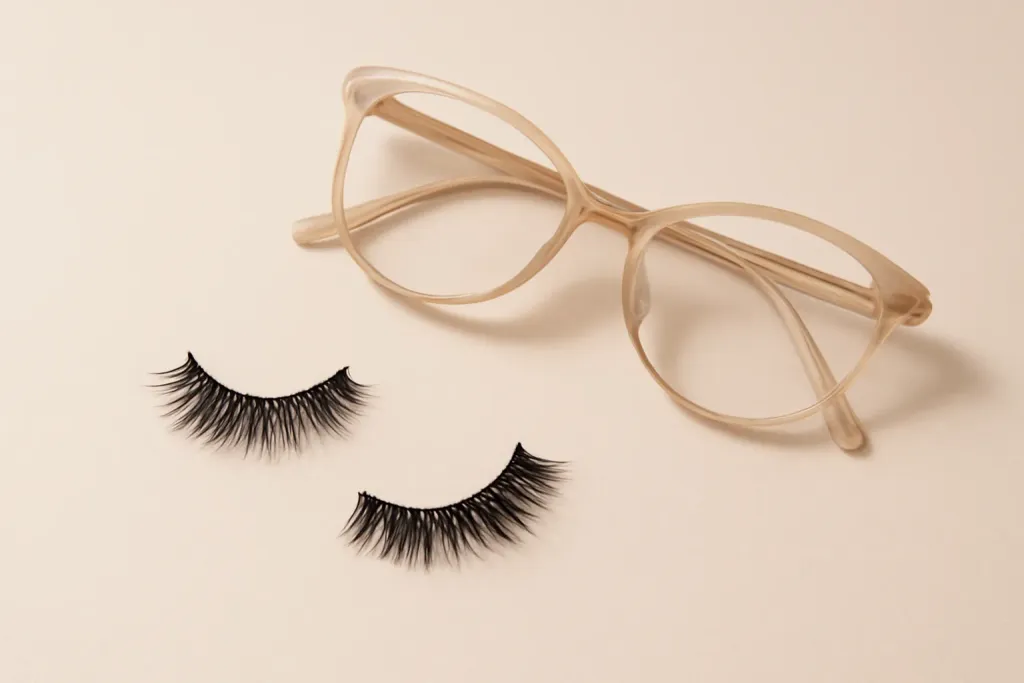
Why glasses change lash choice
Choosing false lashes for glasses takes a little more planning than choosing lashes worn without frames. Glasses create a second visual structure around the eye, so a style that looks balanced on its own can feel crowded, brush the lens, or make the lid area look busier than expected. The goal is not simply to find a pretty strip or cluster, but to find a lash that fits the space between your lash line and your lenses.
When lashes are too long, too dense, or too upright, they can interfere with blinking and drawing focus to the frame instead of the eyes. They may also create a shadow behind the lens that reduces the open, lifted look many people want. The right pair should add definition, not compete with your glasses.
Frames change the overall effect too. Bold frames already give the upper face strong lines, while lighter frames leave more visual room for lashes to stand out. That is why the best false lashes for glasses usually feel more tailored than oversized: they should support your frames, not fight them.
Start with frame shape and lens depth
Before shopping, look closely at your frames. Thick acetate frames and deeper lenses often sit farther from the eye, which can give you more room for a slightly fuller style. Narrow metal frames or frames that sit close to the lash line usually call for a shorter, lighter option.
Frame shape matters as much as fit. Round frames soften the eye area, while angular frames add sharper lines. A lash with a gentle curl and tapered ends tends to work with both because it adds definition without copying the frame shape too closely. Very blunt, uniform fullness can make the eye area feel crowded behind glasses.
Lens placement is worth checking too. If your glasses sit low on the nose, more of the upper lid may show, which can make longer lashes look more obvious. If they sit high or close to the eye, the inner corners may need extra attention so the band does not rub. A quick mirror check while looking straight ahead can show how much space you really have.
Match lash length to lens clearance
The simplest rule for false lashes for glasses is to keep the lash length in proportion to the space above your natural lashes. If the tips touch the lens every time you blink, the style will probably feel distracting no matter how flattering it looks in the package. For many people, short to medium lengths are the easiest starting point because they define the eye without constant contact.
If you want a more noticeable effect, look for styles that build density more than extreme length. Fullness can work well behind glasses when the fibers stay within a practical height. Lashes that are slightly fuller in the center or outer third can open the eyes without forcing the ends into the frame.
Curl matters too. A lash with a stronger curl may clear the lens better than a straighter, longer style because it lifts upward more efficiently. Still, too much curl can look exaggerated behind frames. The sweet spot is a lash that lifts the eye while staying low enough to avoid the glasses.
Choose the right lash style
There is no single best style for every glasses wearer, but some patterns are easier to wear. Softly tapered natural lashes are a dependable choice if you want everyday definition. They add fullness near the lash line and leave the ends lighter, which usually looks neat behind frames. Wispy styles are another strong option because they create movement without a heavy wall of fibers.
If you prefer more impact, look for lashes that are fuller at the base and more open at the tips rather than dense all the way across. That structure often reads as polished instead of bulky. A mild cat-eye shape can flatter many faces, but it may not suit frames that already angle upward, since too much emphasis at the outer corners can make the eye area feel overdone.
Strip lashes and clusters both have a place. Strip lashes are convenient if you want a quick routine and a consistent shape. Small clusters can be useful if you want to place volume more precisely, especially when one part of the frame sits closer to the eye than another. Either way, the goal is to keep your natural lashes visible enough that the result still feels like part of your face.
Browse our recommended products
Our featured picks refresh periodically. While we update them, our editorial guides can help you find the right pick.
See our guides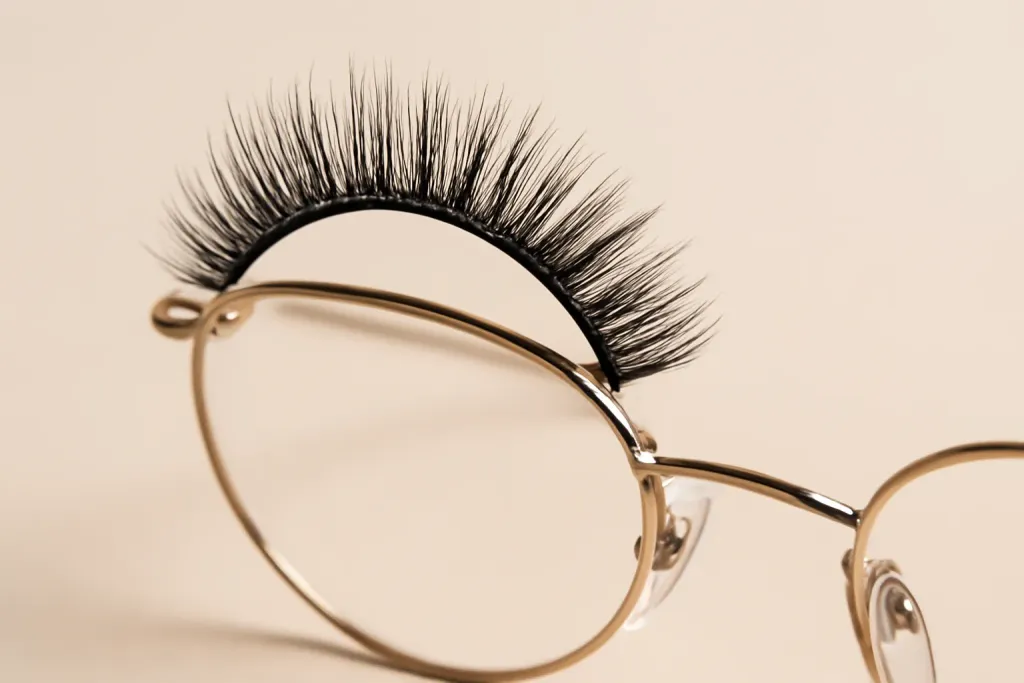
Consider band material and weight
The band can matter as much as the lash design. A flexible band is often easier to fit to the curve of the eye, which may help reduce pressure against the glasses. Stiffer bands can hold their shape well, but they may also sit more prominently on the lid or feel less forgiving during long wear.
Weight is another important factor. Dense, layered styles can look dramatic, but they can also feel heavier and sit closer to the lens. Lighter synthetic fibers or delicate blends are often easier to wear with glasses because they add definition without overwhelming the eye. A feathery texture usually softens the area, while a thick, packed texture can make the frame line feel busier.
When reading product details, focus on words like lightweight, flexible, tapered, and wispy. Those cues often point to styles that are easier to adapt to glasses. The best false lashes for glasses usually balance visible impact with low physical interference.
Fit and customize before wearing
Even a promising lash may need small adjustments before it works with glasses. Trimming the outer edge can help if the strip extends too far toward the frame. Remove a little at a time so you keep the shape balanced and avoid overcutting the lash.
It helps to test the fit while wearing your glasses. Place the lash near your natural lash line, then look straight ahead, down, and to the side. This shows whether the tips come too close to the lens during normal movement. If they do, a shorter style, a lighter band, or a slightly different placement may solve the problem.
Application matters too. If the strip sits too low, it can create extra friction with the lens. If it sits too high, it may feel unstable or look awkward. Aim for a secure placement close to the natural lash line, then make small corrections before the adhesive sets fully.
Pair lashes with makeup and frames
Glasses and lashes work best when they feel like one look. Bold frames usually call for lashes that soften rather than add more weight, while minimal frames can handle a little more definition. Think of the frame, lash line, brows, and shadow as one composition, since each part changes how open the eyes appear behind the lenses.
Makeup can help the lashes look intentional. A thin line of eyeliner close to the lash base can hide the band and create a smoother transition from lash to frame. Light mascara on the natural lashes may help blend everything together, though too much layering can add bulk and reduce comfort. Neutral shadows and neat brows can also support the look without making the eye area feel overloaded.
Frame color plays a subtle role. Dark frames already give the upper face strong definition, so softer lashes may be enough. Light or translucent frames leave more visual openness, which can accommodate slightly more lash presence. The aim is balance, not competition.
Common mistakes and comfort checks
A common mistake is choosing lashes by drama alone. A style that looks striking in packaging may be too tall, too dense, or too rigid once it sits under glasses. Another mistake is ignoring your eye shape and frame size. What works for one face may overwhelm another, so it helps to treat your first pair as a test rather than a final answer.
Comfort should guide the final decision. If you feel constant brushing, pressure, or the urge to push your glasses away from your face, the lashes are probably not the right match. Mild awareness at first can happen, but persistent irritation is a sign to change the length, band type, or placement. If irritation or pain continues, remove the lashes and seek professional care.
Also avoid assuming that more curl automatically solves the glasses issue. Curl can help, but only when it is paired with a manageable length and a flexible band. Very sparse lashes are not always the answer either; if they disappear behind the lenses, they may not give you the definition you want. The best choice sits in the middle: visible, controlled, and comfortable.